
Edge AI Vision Infrastructure Architecture
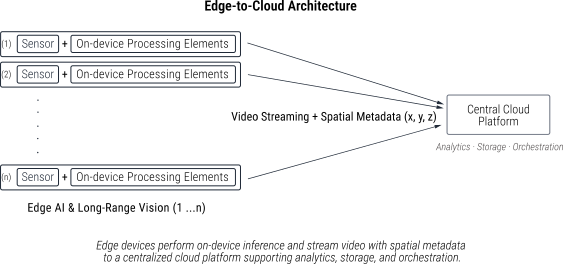
Microseven’s technology stack is designed to deliver real-time visual intelligence in environments where traditional cloud, cellular, and high-bandwidth systems are impractical.
Our architecture combines long-range wireless connectivity, edge-optimized streaming, and structured spatial data output to support AI, analytics, and infrastructure automation.
System Overview
The Microseven platform operates as a distributed edge vision system. Visual data is captured at the edge, transmitted over long-range wireless links, processed by AI systems, and converted into structured spatial data suitable for downstream analysis and automation.

End-to-End Data Flow
- Visual sensing devices capture image and video data at the edge
- Data is transmitted using long-range, low-bandwidth wireless links
- RTSP streams are delivered to AI processing systems
- AI models perform detection, tracking, and localization
- Per-frame spatial outputs (X, Y, Z) are generated and stored
- Structured data is consumed by analytics, automation, or machine learning pipelines

Long-Range Connectivity Layer
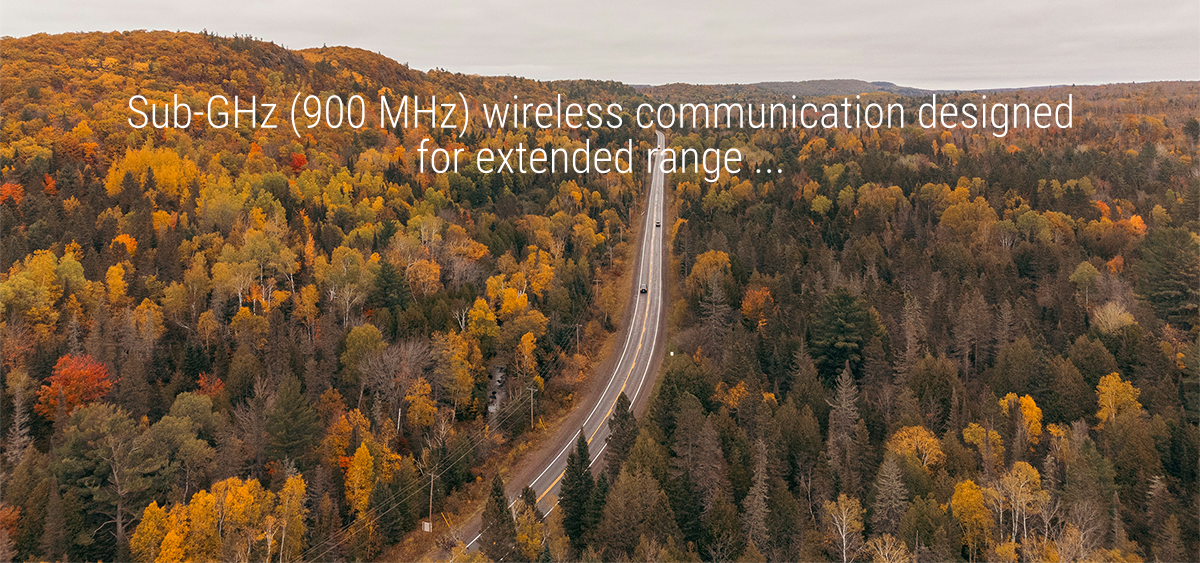
Connectivity is optimized for environments requiring extended range, obstacle penetration, and low power operation. The system supports sub-GHz wireless communication, including 900 MHz architectures, to enable reliable data transport over long distances.
- Sub-GHz (900 MHz) wireless communication
- Extended range beyond typical Wi-Fi deployments
- Improved penetration through structures and vegetation
- Designed for remote and infrastructure environments

Edge AI–Optimized Streaming
The platform supports configurable frame rates and AI-aware streaming pipelines that balance visual fidelity, bandwidth usage, and power consumption.
RTSP-based delivery enables interoperability with existing AI frameworks, analytics engines, and data processing platforms.

Structured Spatial Data Output (X, Y, Z)
Rather than treating video as raw media, Microseven’s system converts visual input into structured spatial data.
For each frame, detected objects can be localized and represented using X, Y, and Z coordinates, enabling quantitative analysis, automation, and machine learning workflows.
- Per-frame object detection and localization
- X, Y, Z coordinate generation
- Time-aligned spatial data records
- Compatible with AI training and inference pipelines
Scalable and Integrable Architecture
The Microseven architecture is designed to scale from single-site pilots to multi-site infrastructure deployments.
Data outputs integrate with cloud platforms, on-premise servers, and analytics systems, enabling flexible deployment models across public and private infrastructure environments.
Technology Developed in Michigan
Core system architecture, data pipelines, and intellectual property are developed and maintained in Michigan.
This work supports applied research, pilot deployments, and collaboration across Michigan’s advanced manufacturing, mobility, and infrastructure sectors.

Field Validation & Pilot Evaluation
Microseven’s edge AI and long-range vision infrastructure is undergoing real-world pilot evaluation with international technology partners. These evaluations focus on Wi-Fi HaLow (IEEE 802.11ah) interoperability, long-distance video streaming, and edge-based AI processing for privacy-preserving analytics.
Pilot deployments include international test environments and feedback cycles with senior engineers from global technology organizations, informing Microseven’s 2026 platform roadmap.